Delhi High Court has held that false statements made by a candidate about their own educational qualifications in election affidavits do not amount to “corrupt practice” under Section 123(4) of the Representation of the People Act, 1951
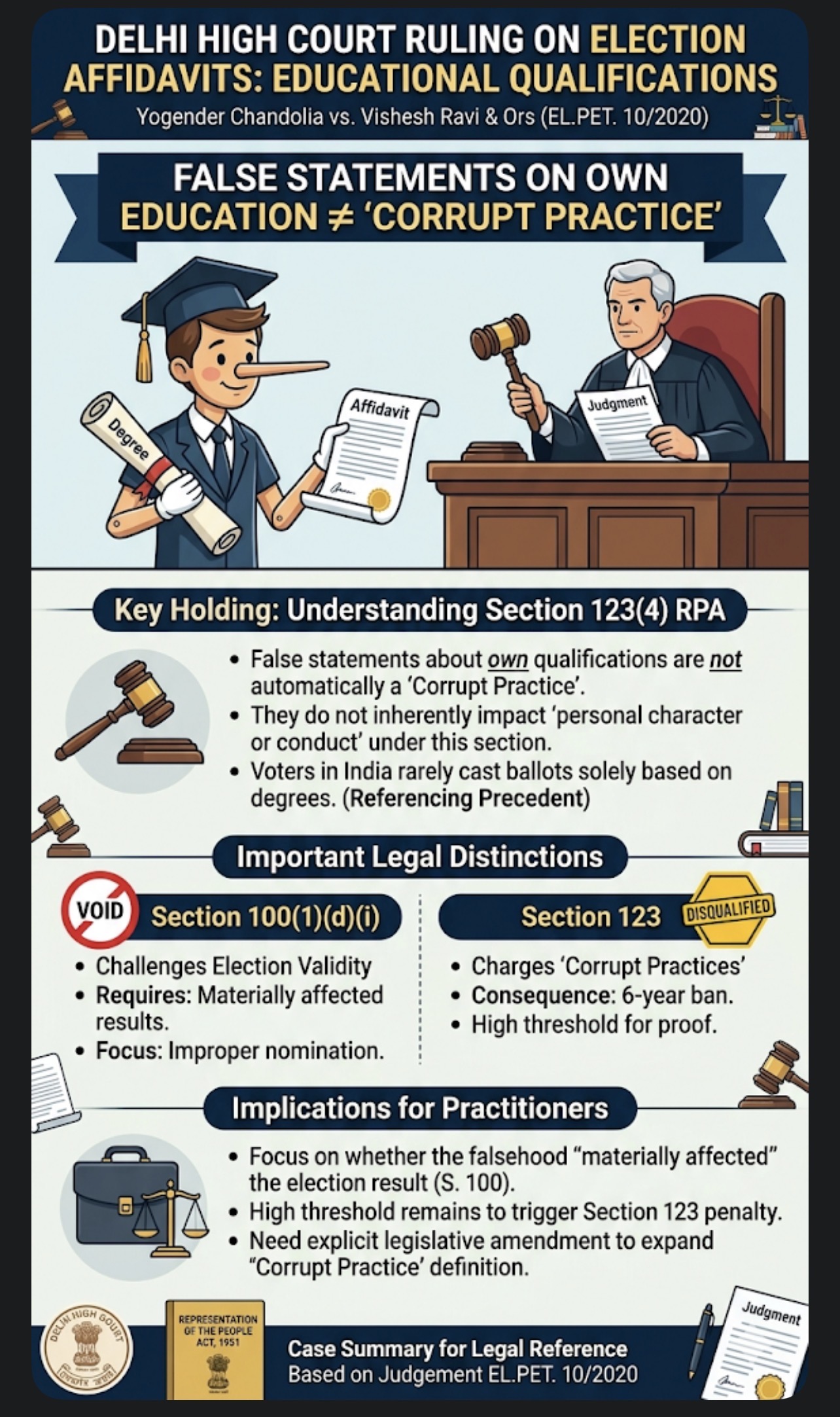
The Delhi High Court, in the case of Yogender Chandolia vs. Vishesh Ravi & Ors (EL.PET. 10/2020), has delivered a significant judgment regarding the scope of “corrupt practices” under the Representation of the People Act (RPA), 1951.
The ruling clarifies whether a candidate’s false declaration about their own educational qualifications in an election affidavit (Form 26) can lead to disqualification.
Key Takeaways from the Judgment
1. Scope of Section 123(4) of the RPA
The Court examined whether misstating educational qualifications falls under Section 123(4), which defines a corrupt practice as the publication of a false statement of fact in relation to the personal character or conduct of any candidate.
• The Ruling: The Court held that while educational qualifications are part of a candidate’s profile, a false statement about them does not automatically qualify as a “corrupt practice” unless it is shown to have a direct and substantial impact on the “personal character or conduct” in a way that unduly influences voters.
• Precedent: This aligns with the Supreme Court’s observation that voters in India generally do not cast their ballots based solely on a candidate’s educational degree.
2. Difference Between “Non-Disclosure” and “Corrupt Practice”
The High Court distinguished between two legal avenues:
• Section 100(1)(d)(i): Improper acceptance of a nomination due to false information. This can make an election “void” if it materially affects the result.
• Section 123: Corrupt practices. Being found guilty here has harsher consequences, including a 6-year disqualification from contesting future elections.
• The Court’s View: The Court was cautious not to expand the definition of “corrupt practice” to every inaccuracy in an affidavit, noting that such a “purposive interpretation” must stay within the strict boundaries of the statute.
3. Judicial Context
The matter was referred to a larger bench to decide specifically whether filing a false affidavit regarding one’s own education constitutes a corrupt practice. The Court noted:
• The Conduct of Election Rules, 1961 (Form 26) requires these disclosures.
• However, without an explicit amendment to Section 123 of the RPA by Parliament, the judiciary cannot easily categorize educational falsehoods as “corrupt practices” unless they are of a “substantial character.”