
🏛️ Commercial Courts Act: Can Courts Grant a ‘Summary Judgment’ on Defendant’s Default? Key Takeaways from Delhi HC
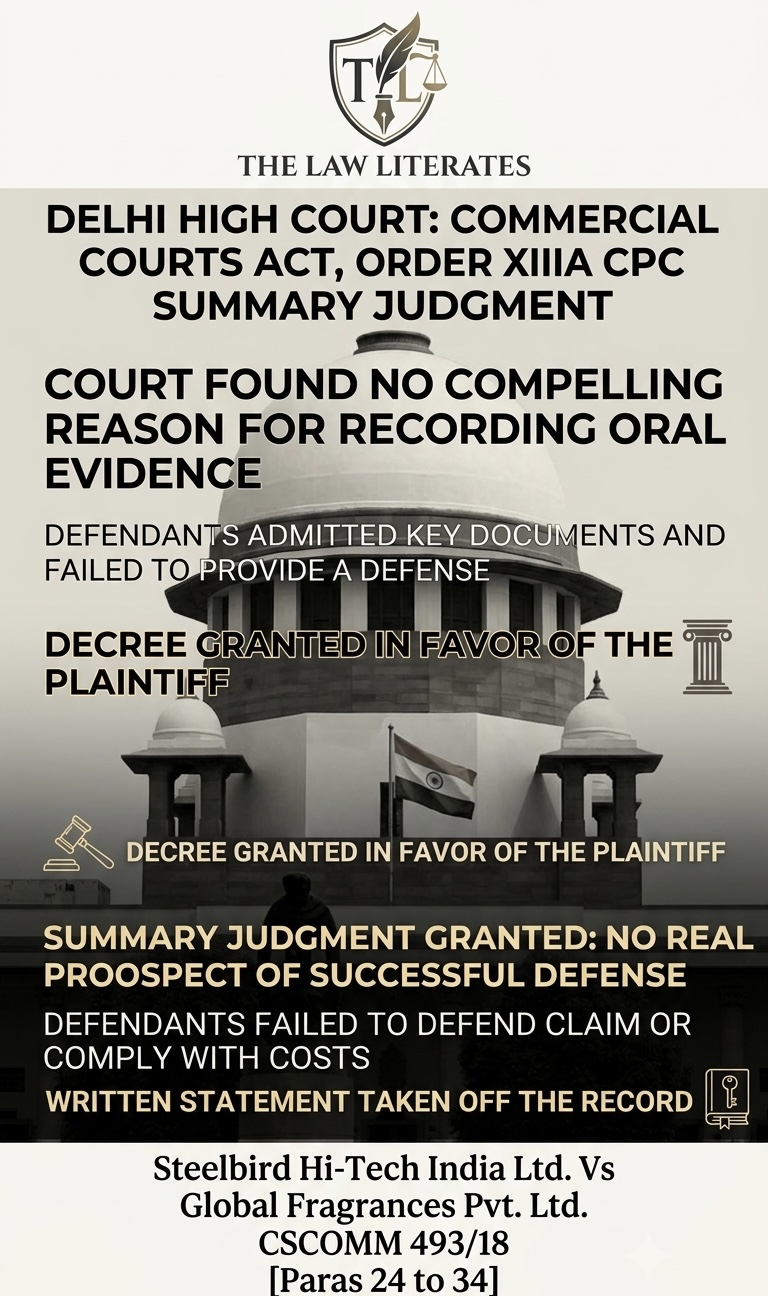
In a significant ruling, the Delhi High Court in the case of Steelbird Hi-Tech India Ltd. Vs Global Fragrances Pvt. Ltd. [CSCOMM 493/18] reinforced the strict application of Order XIIIA of the Code of Civil Procedure (CPC). The Court made it clear that if a defendant has no real prospect of successfully defending the claim, there is no compelling reason to waste judicial time recording oral evidence.
📝 Case Overview
Case Title: Steelbird Hi-Tech India Ltd. Vs Global Fragrances Pvt. Ltd. [CSCOMM 493/18]
Key Provisions: Order XIIIA CPC (Summary Judgment), Commercial Courts Act, 2015
Relevant Paragraphs: [Paras 24 to 34]
⚖️ Factual Matrix & Conduct of the Defendants
The High Court took serious note of the defendants’ non-compliance and the admissions available on record. The summary judgment was triggered by the following crucial factors:
1 Admission of Core Documents: The defendants had already admitted key documents central to the dispute, leaving no material facts to be formally proved via trial.
2 Failure to Respond: The defendants failed to provide a meaningful defense or a substantive response to the plaintiff’s application.
3 Non-Compliance with Costs: The Court had previously imposed financial costs on the defendants for causing deliberate delays. Their failure to comply with these cost orders led to their Written Statement being taken off the record.
🏛️ The Verdict: Law on Summary Judgment Under Order XIIIA
With the written statement taken off the record and key documents admitted, the Delhi High Court invoked its powers under Order XIIIA and granted a decree in favor of the plaintiff.
The Court highlighted two foundational principles:
1. No Compelling Reason for Oral Evidence: A full-fledged trial involving oral evidence is not a matter of right. When the defense is non-existent and key documents stand admitted, forcing a plaintiff to go through a lengthy trial defeats the purpose of the Commercial Courts Act.
2. Lack of ‘Real Prospect’: Under Order XIIIA, a court can pass a summary judgment if the defendant has “no real prospect of successfully defending the claim.” The Court ruled that this was a textbook case fit for a summary decree.
All Rights reserved (The Law Literates)